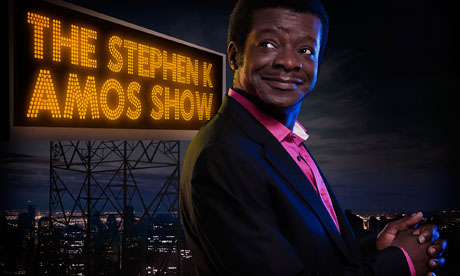

'Was there one moment I decided that I wanted to be a comedian? Absolutely not'
January 29, 2010
JONPAUL HEDGE
thisissouthdevon.co.uk[/align]
STEPHEN K Amos is a rule breaker. Well, he mocks the traditional route into comedy. He's a man who wasn't a fan of comedy, didn't watch comedy and wasn't interested in comedy. In fact, it is small mercy for his increasing hoards of fans that he ever developed a sense of humour.
"For me there's no history when it comes to comedy," he said. "I didn't watch comedy on television. My parents weren't big fans. I didn't do comedy clubs. Was there one moment when I decided that I wanted to be a comedian? Absolutely not. I had no interest in comedy. I had always been quite funny or mad or whatever, but was on-course for a normal career.
"I had just finished a law degree and was just about ready to go onto the next stage. One day I was travelling to New York and this woman said: 'Oh my God, you are so funny'. She asked: 'Why don't you do stand-up comedy?' I told her not to be ridiculous and that I might be funny in one-to-one in conversations, but stand-up would be totally different. I went to the Comedy Club in London, originally to watch, and ended up doing a sketch. It was just as simple as that."
Stephen comes from a big family with four brothers and four sisters, one of whom is his twin. When he first decided he wanted to start in comedy he said he initially faced some scepticism from his family. "My family say that they can picture it now," he said. "They say that I was always mucking around, never paying attention. I was never academic in terms of science subjects. I had resistance from my parents. Obviously, when you go down that career people worry. But now that things are working they very proud."
You could forgive his family for being a little concerned over his new career choice. First time out, Stephen didn't practice. Then again, he thought it was just reading out loud. "There was no traditional route for me," he said. "First time I performed I didn't practice. I think that's how I've developed the style that I have. I presumed that what people did was go up on stage with a piece of paper and read out jokes. And that's what I did, to the joint hilarity and absolute disgust of the audience. I obviously now realise that a lot more work is involved."
Stephen was speaking to me from a hotel room in Aberdeen, currently on a national tour. The show, which will come to Torquay's Babbacombe Theatre next week, is a break from the likes of Have I Got News for You, Mock the Week, Live at the Apollo, Stewart Lee's Comedy Vehicle and The One Show. The television exposure now means he is recognised more.
"I don't mind that," he said. "Particularly if they are nice people. The show isn't rocket science. I always say to people that if you don't like what I do, then don't come and see it. But nine times out of 10, people have had a laugh and just want to come and express that."
Stephen says the more comedy he did, the better he got until he reached a consistent level of performance. "Thankfully, I didn't have to work at working men's clubs but once I was on the 'comedy train' I've worked hard at it," he said. "That said, I didn't think that one day I would be doing my own national tour or that I'd have my own series on television. What happened to me is that I just started to get very consistent, I wasn't having up and down gigs. I learnt how to work my audience, I leant how to sell my material and make a personality work. I can't pinpoint a time where I thought that I had cracked it, it has been more a case of just being consistently better."
His new show The Feelgood Factor comes fresh from a triumphant run at the Edinburgh Festival, where he played to 16,740 rapturous fans. The 70-date tour will culminate at the Hammersmith Apollo in London.
"I'm trying not to dwell on all the negatives that have happened recently – the financial crisis, the MPs' expenses scandal, the fact that no-one has faith in the Government anymore. I talk about all the little things in life that make you feel good. Audiences are crying out for something like this. Shows like the X Factor are getting massive audiences. People want escapism, and people want a laugh. For instance, I'll be remembering the joy I experienced as an eight-year-old boy running downstairs to beat my brothers to the toy hidden at the bottom of the cereal packet. It was always a bike reflector. I didn't have a bike, but I was still determined to get there first. If you remind people of something like that from your childhood, they all go: 'That happened to me, too'. That creates a very warm feeling."
Stephen added: "I went round to my brother's the other day and his five-year-old son was laughing uncontrollably. I asked him why he was laughing, and through tears, he replied, 'I don't know.' Then I started laughing uncontrollably, too. At that point, my brother came in and asked: 'What's going on'? At first, he didn't get it. My question is: What happens to that wonderful sense of childhood innocence when we grow up?"