
While filming, he has been staying in a hotel by the Thames, an establishment more refined than Alan Partridge's motel and one where staff have resisted the temptation to serve Coogan's food on an oversize plate. For an hour and a half, he sits at a picnic table in the hotel grounds, still wearing the hair extensions that transform him into Saxondale - a rock roadie turned rodent-exterminator, fighting to reconcile his self-image as a counter-cultural child of the Sixties with his reality as a bearded pest-controller in small-town Hertfordshire - and explains his dedication to making British television comedy.
"More than ever, I now appreciate being able to do interesting work in television. It matters to me. You can be blinded by the lights of Hollywood, especially when you think there's this pot of gold somewhere. It's not healthy. Saxondale stops me selling my soul, basically."
In part, Coogan's willingness to stay away from LA and write television scripts day after day in the office at the top of his house in Hove is due to frustration with the fact that Saxondale, weighed down by the public hunger for a new incarnation of Partridge, has not enjoyed the ratings that its creator feels it merits.
"I was a bit disappointed that [the show] didn't capture the public imagination. If people have a certain expectation and it doesn't immediately fulfil that, they look at something else. You don't get an immediate fix of visceral comedy within the first 10 seconds [of Saxondale]. It really rewards application if you listen to it and pay attention. There's lots of layers in there and lots going on," he says. "He is my favourite character, because for me he's more complex than any of the other characters I have done."
The second series is the result of nine months of working with his co-writer and executive producer Neil Maclennan, who lives nearby, and joins Coogan in the task of smothering the office walls in Post-it notes of ideas. "In the end, there's no substitute for sitting down and putting the hours in. It's a good discipline to write every day for several months and take your time over it. The office looks out over my back garden and beyond that to Sussex cricket ground, and we occasionally hear cheers and 'Howzat!' when we are writing. The cheers are not for us, though - I wish they were."
This is not to paint Coogan as a twisted funny man grinding his teeth in frustration at the humourless masses who fail to appreciate his talent. How could he feel unloved when he has three feature films in the pipeline? What's more, he is a pragmatist and a student of the science of comedy. According to Henry Normal, his business partner at Baby Cow productions and friend of 20 years, "comedy is somewhere between mathematics and music - there's a rhythm to it".
Coogan understands that a multi-layered character such as Saxondale - who is at once a wit and a bore, a rebel in suburbia, a man of principle and a prig - is going to be a bit rich for some sections of the comedy audience. "The British have an opposition when you try to be at all intellectual with your comedy - there's a deep mistrust and suspicion of that. They say, 'Just be funny, don't try to be clever.' But we wanted to do comedy that was about something, have the character articulate something about the baby-boomer generation that is now getting old and disconnected with the world. Nobody has properly articulated that."
Saxondale, Coogan says, is a metaphor for a world in flux, where the members of those generations that grew up with a common disgust for the Vietnam War or the policies of Margaret Thatcher now don't quite know where to vent their spleens. "When Tony Blair walked in to Downing Street with an electric guitar 10 years ago, it confused everything," he says. "The war in Iraq... it wasn't a Conservative government that oversaw that war. It's complicated and confusing. It isn't clear-cut. That's what Saxondale is about. It's slightly directionless anger."
So in series two we see Tommy welcoming squatters to his Stevenage neighbourhood, warming to these kindred spirits until his more conservative midlife instincts surface. "Although he's not a Trotskyist or anything, he empathises with the squatters because he imagines them to be like a last bastion of opposition, although they're just a load of drug addicts and stoners. He wanted to like them, but when he went round to the house... oh my God, they were just grotesque. He told them to tidy up and pull themselves together." The scene recalls an episode from the first series, in which Saxondale is confronted by a group of aggressive animal-rights vigilantes and responds by shooting one of them, Dirty Harry-style, with his pellet gun.
Coogan breaks off for a second to retrieve a ball for some children playing nearby. The day after the Saxondale wrap party he is no longer sporting a beard - he has shaved it off in order to play a second character in the series, a camp and hare-brained raver living in high-rise squalor. "He's a gay Mancunian heroin addict, an anorexic Emo guy called Keanu Reeves who changed his name by deed poll and wears different coloured winkle-pickers." Playing both roles meant that Coogan had to use a false beard for part of the filming. "It's quite hard shooting a scene where you have to have an argument with yourself."
Coogan had, of course, hoped that Saxondale would take off of its own accord, and chose to do minimal publicity for the first series, perhaps not entirely convinced by his own work. "The last series came out during the World Cup, which didn't help. But I didn't put my head above the parapet. Now, I believe it's a good show and I will say it to people."
At least the Americans are taking notice. The NBC network has a format deal with Baby Cow and an American version of Saxondale has already been written. Coogan believes the Mustang-driving lead character is likely to resonate with US audiences. "There's an American element to him. We were going to call the series The Wild One - the slightly romantic view of the lonesome cowboy who survives by himself. He has an American heart. When he drives down the A1M, he thinks it's Route 66."
Then there's the fact that, in the US, Coogan isn't laden with the legacy of Partridge. "The American critics were slightly less encumbered with preconceptions about me. It wasn't as if Alan Partridge was a huge hit in America," he says of the favourable response to the first series of Saxondale after it ran on BBC America. Even so, Coogan is aware that the market for British comedy in America is still niche, although it is popular in key Hollywood circles. "It's kind of a culty thing, but a lot of the comedy establishment like British comedy. Matt Stone is a big fan of Alan Partridge and loved The Day Today. Ben Stiller is a fan of my stuff, as is Jack Black."
He and Larry David have such a mutual appreciation that Coogan appears as a psychiatrist in the new series of Curb Your Enthusiasm, which might make Ricky Gervais a little jealous. Coogan weighs the merits of British and American comedy. In the US, he says, there is a "rigorousness" and "consistency" to the work that results from the many tiers in the commissioning process. But this is a "double-edged sword" and the lack of such safety nets can allow a quirky gem of a British production to make it to air.
"In Britain sometimes, if the programme controller likes something it gets commissioned. That would be anathema to the Americans, because ultimately it's all about the bottom dollar. This country's comedy at its best, at its absolute best, is better than theirs, to be honest, because you have these almost aberrations, where events conspire every now and then to make these programmes where someone likes it and gives them a break, and you get something like Little Britain or The Office. But America does have rigorousness and they're just more organised."
When Coogan is in LA, he only tends to get recognised in "cool record shops" such as Amoeba, which has a section dedicated to his DVDs. His standing in such circles was raised by his role as Mancunian impresario Tony Wilson in Michael Winterbottom's film 24-Hour Party People. He is working with the director again on Murder in Samarkand, a film based on Craig Murray, the outspoken former British ambassador to Uzbekistan. "It's about people's human rights violations and torture." Not exactly a rib-tickler, then. "That's where you're wrong, you see - not ordinarily, but Michael will find a way."
Murray, says Coogan, is "recklessly truthful" and "heroically flawed", the sort of well-intended but slightly damaged character that he relishes. He is playing a "self-delusional" American high school drama teacher in Hamlet 2, directed by Andrew Fleming, and even confirms his interest in a film version of the life of the inept skier, Eddie "The Eagle" Edwards. "That's a very real project that I'm attached to. When and where I don't know, but it is real. It's out there and there's a script and a director."
Yet another flawed character, a media professional, very nearly took the place of Saxondale, he reveals. "Myself and Neil developed two characters in tandem. The other was much more of a contemporary character, a journalist-stroke-TV presenter. A very edgy, zeitgeisty, �ber-trendy, post-modern, smart, savvy... annoying character."
Coogan, at Maclennan's behest, even wrote an episode in which the character - "Bill Cookson, I think we were going to call him" - gets excited at a dinner party when he listens to a rap album and hears a real drive-by shooting. "It's that slightly odd fascination with deprivation and danger that grammar school and university boys are attracted to, but don't actually want to be part of... trying to be very hip and with-it, but underneath very conservative." There are few of us in the media who might squirm a little if this character ever makes it to television, not least among them William Cook, The Guardian's comedy and TV writer.
It wouldn't take a shrink or a television critic to work out that Coogan's fascination with complex characters who aim high but end up getting burned is partly based on his own mixture of experiences in the limelight, mercilessly and mirthlessly documented in the Sunday tabloids. He says obsession with flawed personality, or at least Schadenfreude over a fallen star, is a "national sport". As with comedy, there is a marked difference between Britain and America, and again it is a "double-edged sword". The "Brave New World Soma-taking" adoration of anyone successful that he experiences in Hollywood contrasts with the endless complaining that he notices as soon as he returns to the UK. "We've got much better bullshit-detectors in this country, but sometimes it makes you think that everything is bullshit and you end up living a cynical life."
With Tommy Saxondale, however, he thinks he has found a character with an essential truth. "I wanted somebody I could tread a line with, to try and do something that isn't done very often, which is a character who is likeable in some respects and objectionable in other respects, and is complex like human beings are complex, rather than just a ridiculous, contemptible comic figure. Unlike other characters I've done, he's funny and he knows he's being funny. But he's also a jerk sometimes. I like the fact that you think he's an ass and then suddenly you engage with him and think, 'He's speaking for me'."
At the age of 41, Coogan is too young to be a baby-boomer and too sharp to hanker for slippers and a semi in Stevenage. Surely, he's more the edgy, zeitgeisty Bill Cook-type? But listen carefully and even this most ground-breaking, unconventional comic creator has a streak of Middle England among his own multi-layered identity. "I've been staying in this hotel and I said to Neil, 'It's very relaxing. There are no trendy people here, there's no people who are edgy or zeitgeisty within a two-mile radius.' And that's really nice. Ten years ago I would have said, 'Look at this place, it's full of Surrey Daily Mail readers, aren't they annoying?' I suppose I'm getting older."
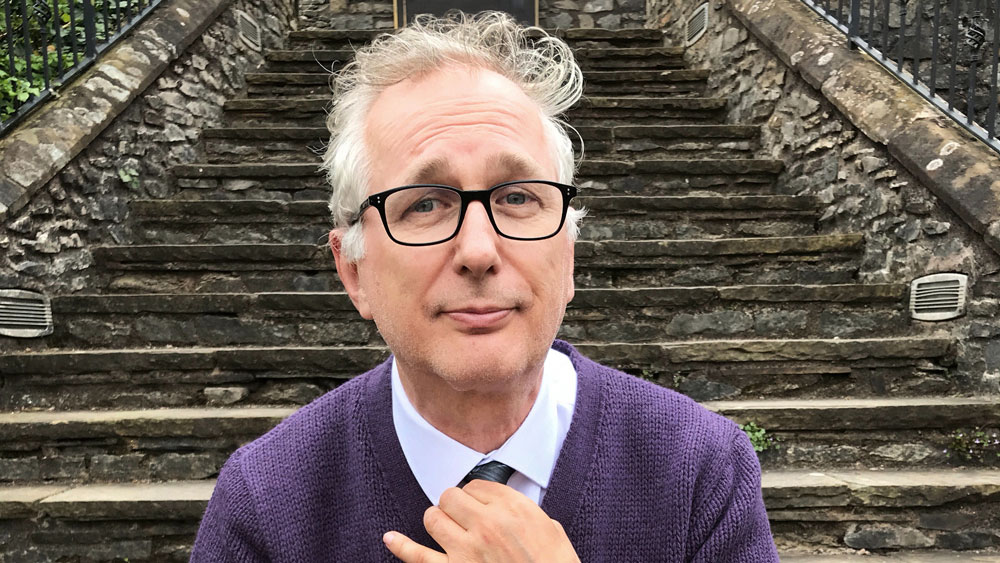
The Normality Behind Coogan
'I like a cup of tea and an Eccles cake'
The comic characters they have carved out are not inspired by nights of boozing - Steve has had to find the company for those elsewhere. "I don't socialise with anybody, it's as simple as that," says Normal. "When I'm at home, I exist in another world, a bit like an astronaut who works in space. I like a cup of tea and an Eccles cake and I like to watch television and films."
In the office Normal is another person, overseeing a slate of comedy hits that includes The Mighty Boosh (shortly to start filming a third series), the award-winning Julia Davis sitcom Nighty Night, and Ideal, which is about to begin its fourth season ("It's the best piece of work that Johnny Vegas has ever done").
Normal thinks outside the box, particularly where "box" means television. He is overseeing a YouTube-based project, Where Are The Joneses?, some 100 bite-sized episodes showing a deranged woman's mission to locate her 27 half-siblings from a list obtained in a sperm bank. The film project even pays its way with a sponsor's logo at the end of each clip. "Ford have put up all the money," says Normal. "Yes, she drives a Ford S-Max, but I've got to say we've had no instructions from Ford to feature the car." Not that he is unqualified in his praise of YouTube. Excerpts of other Baby Cow shows have been placed there illegally, he says. "A lot of people have worked very hard on those shows and the idea that they become public property - I don't agree with that."
Coogan has used Normal's Nottingham accent for the character of Tommy Saxondale. "You could think that, with a 50-year-old bloke who likes progressive rock and speaks with a Nottingham accent, Steve might be tekkin' the mick," says Normal. "But I don't do pest control. At least not as a day job."
A new series of 'Saxondale' begins on BBC2 at 9.30pm on Thursday, 23 August
---------------------
That's interesting to hear that he will be in the enxt series of Curb. I'm sure that did get up Gervais' nose for sure - but then, Coogan is lesser known in America so he will probably be accepted easier in the role.
Steve Coogan - 2002-11-09 - Parkinson